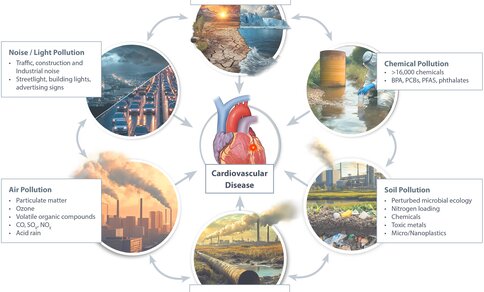
The world's leading cardiology societies – European Society of Cardiology (ESC), American College of Cardiology (ACC), American Heart Association (AHA) and World Heart Federation (WHF) – have published their first joint policy statement. In it, they call for decisive political action against environmental stressors as a key cause of cardiovascular disease.
The statement makes it clear that air pollution, traffic, aircraft and industrial noise, artificial light, chemical pollutants, plastic and climate-related extreme events pose a significant and hitherto underestimated threat to heart health. According to current estimates, 4 to 6 million of the approximately 20.5 million cardiovascular deaths worldwide each year are attributable to environmental pollution. This means that around one in five cardiovascular deaths is caused by environmental factors.
Silent accelerators of cardiovascular disease
‘Cardiovascular diseases remain the leading cause of death worldwide, and environmental stressors act as silent accelerators,’ explains Professor Thomas Münzel, lead author of the statement and cardiologist at Mainz University Medical Centre. ‘Clean air, quieter cities and a stable climate are not purely environmental goals, but prerequisites for effective prevention of heart disease.’
Professor Thomas F. Lüscher, President of the ESC and senior author of the document, also emphasises the need for a rethink: ‘The heart does not exist in isolation. It beats in an ecological environment. Environmental pollution must be given the same priority in cardiovascular prevention as smoking, high blood pressure or diabetes.’
Unevenly distributed burdens
Socially disadvantaged population groups and low- and middle-income countries, which suffer disproportionately from environmental pollution and the effects of climate change, are particularly affected. The authors therefore call for coordinated political measures to effectively reduce individual and societal environmental impacts.
‘The scientific evidence on the health consequences of air pollution, noise and heat is clear,’ says Dr. Christopher Kramer, president of the American College of Cardiology. ‘Now is the time to act to sustainably reduce the global burden of disease from cardiovascular disease.’
The World Heart Federation also emphasises the urgency of the situation. ‘To prevent cardiovascular disease, we must tackle its causes,’ explains Professor Amam Mbakwem, Vice President of the WHF. ‘Environmental pollution particularly affects the most vulnerable. That is why immediate action by all social actors is necessary.’
Six areas of action for politics and health systems
The joint statement identifies six key areas of action:
- Stronger political anchoring of environmental factors in heart disease prevention
- Targeted investment in research on the environment and heart health
- Education of healthcare professionals and the general public
- Health-oriented urban and transport planning
- More sustainable health systems
- Climate-resilient care structures
The declaration concludes with a clear appeal: only by tackling the causes of environmental stressors can cardiovascular disease be effectively reduced and healthier, more fair and more sustainable societies be created.
Publication:
Münzel T, Lüscher T, Kramer CM, et al. Environmental stressors and cardiovascular health: a statement of the European Society of Cardiology, the American College of Cardiology, the American Heart Association, and the World Heart Federation. Eur Heart J. 2025. https://www.ahajournals.org/doi/10.1161/CIRCULATIONAHA.125.079034