People with a leaking tricuspid valve frequently experience progressively reduced exercise capacity, breathlessness on exertion, fluid retention, and recurrent hospitalisations. The incidence of the condition increases with advancing age and, if left untreated, leads to progressive heart failure. Although the tricuspid valve has been amenable to minimally invasive repair for some years, whether this treatment also improves the course of the disease has, until now, remained unclear.
A study published simultaneously in the New England Journal of Medicine and presented at the annual congress of the European Society of Cardiology (ESC) now demonstrates for the first time that minimally invasive tricuspid valve repair reduces the risk of heart-failure-related hospitalisation and premature death.
The TRIC-I-HF (TRICuspid Intervention in Heart Failure) DZHK24 study, initiated and funded by the German Centre for Cardiovascular Research (DZHK), examined 360 patients with a mean age of around 80 years. All participants had severe tricuspid regurgitation and were at high risk of heart failure complications. Twenty-nine specialised heart centres across Germany took part in the study.
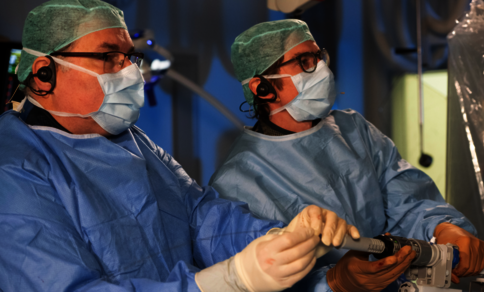
Participating patients were randomly assigned to receive either minimally invasive valve repair in addition to optimal medical heart failure therapy, or medical therapy alone. During the minimally invasive procedure, a catheter is advanced through the femoral vein to the heart. In most cases, small "clip" implants are then attached to the tricuspid valve, connecting two of the valve leaflets (tricuspid valve clipping). This allows the valve to close more effectively, reducing the backflow of blood.
Clear Clinical Benefit of Tricuspid Valve Repair
The TRIC-I-HF DZHK24 study demonstrated a clear clinical benefit: the combined risk of heart-failure-related hospitalisation or premature death fell by 60 per cent compared with medical therapy alone. The treatment effect was so pronounced that only four patients needed to be treated to prevent one endpoint event (death or heart-failure-related hospitalisation). Patients' quality of life and physical exercise capacity also improved. At the same time, the study showed that these procedures can be performed with a high degree of safety and few complications, even in older patients with multiple comorbidities.
Earlier randomised trials had already shown that minimally invasive tricuspid valve repair alleviates symptoms and improves quality of life. However, whether the procedure could also prevent severe disease progression and reduce the risk of hospitalisation or death had, until now, remained unclear.
"For patients with advanced heart failure, minimally invasive tricuspid valve repair opens up a new treatment perspective. In the TRIC-I-HF study, patients at elevated risk of future heart failure events were selected. This population essentially corresponds to the patients we had already been treating as part of routine clinical practice. The results demonstrate convincingly for the first time that the procedure not only improves quality of life but can also prevent severe disease progression."
Prof. Thomas Stocker, LMU University Hospital Munich, joint first author and study lead of the TRIC-I-HF DZHK24 study
"One reason for the positive results of the study is likely to be, alongside targeted patient selection, the growing experience with interventional tricuspid valve therapies. Unlike in earlier studies, particularly experienced centres took part, which on average had already performed well over 100 transcatheter tricuspid valve procedures prior to the start of the study."
Prof. Jörg Hausleiter, LMU University Hospital Munich, joint first author and study lead of the TRIC-I-HF DZHK24 study
The treatment also proved to be safe: serious complications within the first 30 days after the procedure occurred in fewer than six per cent of treated patients.
"The results show the contribution that independent academic studies can make to patient care. Together with 29 heart centres, we succeeded in generating robust evidence on a question that is of great importance to many people with heart failure."
Steffen Massberg, Director of the Medical Clinic and Polyclinic I at LMU University Hospital Munich and Board Member of the German Centre for Cardiovascular Research (DZHK)
The findings suggest that minimally invasive tricuspid valve repair will play a considerably more prominent role going forward in the treatment of selected patients with severe tricuspid regurgitation.
Background: The Long "Forgotten" Heart Valve
The tricuspid valve is one of the four heart valves. It is located between the right atrium and the right ventricle and prevents blood from flowing back into the right atrium during each heartbeat. When the valve no longer closes properly, this is referred to as tricuspid regurgitation. Severe regurgitation can lead to breathlessness, fluid retention, reduced exercise capacity, and repeated hospitalisations due to heart failure.
For a long time, the tricuspid valve was regarded as the "forgotten heart valve". While diseases of the aortic and mitral valves have been treatable surgically, and later also via minimally invasive methods, for many years, suitable treatment options for the tricuspid valve remained scarce. Many affected patients are older, suffer from advanced heart failure, and therefore carry an elevated surgical risk. In addition, the complex anatomy of the tricuspid valve makes minimally invasive procedures particularly technically demanding. Corresponding catheter-based techniques were therefore only developed around ten years ago.
Today, the tricuspid valve can in many cases be repaired minimally invasively via catheter. In this procedure, a small implant is attached to the valve leaflets so that the valve closes more effectively and blood backflow is reduced. The natural heart valve itself is preserved.
Publication:
Tricuspid-Valve Intervention in Heart Failure, New Enland Journal of Medicine, 2026, DOI: 10.1056/NEJMoa2606934
More on the study:
https://tric-i-hf.dzhk.de/